Guides
Delay Social Security Even When COLAs Are High. Here's Why
A higher cost-of-living adjustment raises every beneficiary's check, but the dollar gain is larger for those who waited because COLAs compound on a bigger starting benefit.

Analysis — A 2.8% cost-of-living adjustment for 2026 does not make early Social Security claiming a bargain. Workers who wait from full retirement age to 70 still earn delayed retirement credits worth roughly 8% a year, and every future COLA compounds on that larger starting benefit. For most healthy retirees, the math still favors patience.
How Delayed Credits Work
For anyone born in 1960 or later, full retirement age is 67. Claim at exactly that age and you receive 100% of your primary insurance amount, the benefit calculated from your 35 highest-earning years. Claim earlier and Social Security lops off about 6.7% a year for the first three years and 5% for each additional year. Filing at 62 therefore locks in a payment equal to only 70% of the full benefit.
Wait beyond full retirement age and the direction reverses. The Social Security Administration adds roughly 8% for each year you delay, up to age 70. Someone with a $2,000 monthly benefit at 67 would collect $2,480 at 70, a 24% raise that lasts for life. Those credits stop at 70, so there is no financial reason to delay past that birthday.
| Assumption | Value |
|---|---|
| Full retirement age (FRA) | 67 (born 1960 or later) |
| Primary insurance amount (PIA) at FRA | $2,000/month |
| Claiming at 62 | 70% of PIA = $1,400/month |
| Delayed retirement credits, 67 → 70 | +8% per year → +24% total = $2,480/month |
| COLA applied in projections | 2.8% for 2026 |
Why a High COLA Still Favors Waiting
The 2026 COLA is 2.8%, per the Social Security Administration's COLA fact sheet, up from 2.5% in 2025 and the first uptick since the 8.7% increase for 2023. The adjustment applies to benefits already being paid, so a retiree collecting $1,400 a month gets an extra $39 a month next January. A retiree collecting $2,480 gets an extra $69. The percentage is identical; the dollar gain is not.
That gap widens over time because next year's COLA is applied to this year's already-larger number. A 2.8% raise on $2,480 is worth about $830 a year; the same raise on $1,400 is worth about $470. The base matters more than any single COLA announcement. Waiting does not merely buy a bigger check today; it buys a bigger platform for every inflation adjustment that follows.
A Worked Example: Maria in Toledo
Maria, 61, is a registered nurse in Toledo, Ohio. Her Social Security statement estimates a $2,000 monthly benefit if she claims at 67. She is healthy, her mortgage is paid off, and she could cover expenses until 70 by working part-time. She is tempted to file at 62 because the 2026 COLA looks generous.
If Maria claims at 62, her starting check would be about $1,400. If she waits until 70, it would be $2,480. Ignoring COLA, the 62 path gives her an eight-year head start of roughly $134,400. The $1,080 monthly gap closes that head start around age 80. After that, every additional year puts the delayed filer further ahead.
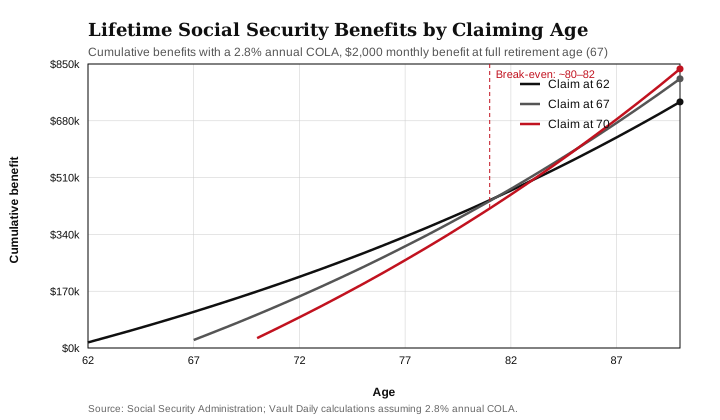
Add the 2.8% annual COLA and the monthly gap widens, but the cumulative crossover drifts toward age 81 or 82. Before COLA, the delayed-claim total is ahead by roughly $60,000 at age 85 and roughly $125,000 at age 90 in nominal dollars. With COLA applied, the dollar leads are smaller in the early 80s but accelerate once the crossover is passed. The directional point is clear: longevity is the friend of the delayed filer.
Break-Even Ages
Break-even math compares the extra checks you collect by claiming early against the larger checks you collect by waiting. For a worker with a $2,000 full-retirement-age benefit, the crossover between claiming at 62 and 67 lands around age 78–79. The crossover between claiming at 62 and 70 lands around age 80–82. Claim at 67 and the break-even against waiting until 70 is roughly age 80–81.
Those ages are averages, not guarantees. The Social Security Administration's own Retirement Estimator can produce personalized estimates using your actual earnings record. Anyone in poor health, with a family history of early mortality, or without other income should treat the break-even age as a forecast, not a promise.
Common Mistakes
The biggest misconception is that a high COLA is a reason to claim early. The logic seems intuitive: inflation is eroding purchasing power, so grab the money now. But COLAs are percentage increases. A higher percentage on a permanently reduced benefit still leaves you with a permanently reduced benefit. The 2026 adjustment helps early claimers less in absolute dollars than it helps late claimers.
Another mistake is ignoring the earnings test. Workers who claim before full retirement age and keep earning face withheld benefits if wages exceed an annual limit. In 2026, Social Security withholds $1 in benefits for every $2 earned above $24,480 for people who will not reach full retirement age during the year. The money is not lost forever, but the effective cash flow can disappoint claimants who expected immediate income.
Married couples sometimes overlook spousal benefits. A lower-earning spouse can collect up to 50% of the higher earner's full retirement benefit, but spousal benefits do not earn delayed credits. In that case it often makes sense for the higher earner to delay and the lower earner to coordinate a claim that does not accidentally trigger a reduced payment on both records. The glossary defines deemed filing and other terms.
When Waiting Is the Wrong Call
Delaying is not universal advice. A retiree who needs the cash at 62, who is single with serious health problems, or who has a shorter-than-average life expectancy should usually claim earlier. The 8% annual credit is valuable only if you live long enough to collect it.
Some households also come out ahead by claiming early and leaving retirement accounts untouched, especially if the portfolio can grow at a rate that exceeds the implicit return from delaying Social Security. Taxes complicate the comparison: benefits can become taxable once provisional income crosses $25,000 for single filers or $32,000 for joint filers, thresholds set in 1984 and never indexed for inflation. Use the 2026 tax-year checklist to estimate where your income lands.
The Bottom Line
More than 11,000 Americans turn 65 each day from 2024 through 2027, according to Visa Consulting & Analytics, making this the densest retirement wave in U.S. history. For the healthy majority of that cohort, the 2026 COLA reinforces rather than weakens the case for waiting. Delayed retirement credits still add about 8% a year, and every future inflation adjustment compounds on a larger base.
The decision is ultimately a bet on longevity and liquidity. If you can afford to wait and expect an average or longer lifespan, the higher starting benefit wins. Claim early only when you need the income, doubt your longevity, or have a compelling reason to keep other assets invested. The COLA is a raise for everyone; the size of your raise depends on the size of your benefit.
Sources: SSA COLA fact sheet; benefit estimates via the SSA Retirement Estimator. Last verified Sept. 4, 2026.
Keep Reading
AI Grocery Lists: How to Check Whether They Help
A practical comparison method for grocery planning. The earlier household pilot and claimed savings were not supported by verified records.
Before Linking a Budgeting App to Your Bank
Questions to resolve about account access, household visibility, data retention and disconnection before connecting a budgeting app.
Budgeting Categorization: Synthetic Example, Not a Test
A correction to the former eight-app benchmark and a reproducible explanation of the 120-row synthetic categorization example.