Reviews
YNAB vs Monarch Money: Budgeting and Household Access
One app assigns every dollar a job; the other gives a household one shared dashboard. The documentation says the difference is structural, not cosmetic.
Source-based analysis — YNAB costs $109 a year and makes every dollar carry an assignment. Monarch Money costs $99.99 a year and gives a whole household one shared view of its money. The two apps disagree about what a budget is. This comparison draws on each company's published pricing, documentation and support pages, checked September 14, 2026.
Two Budgets, Two Theories of Money
YNAB, short for You Need A Budget, sells one subscription and one method: zero-based budgeting, where money you actually hold is assigned to categories before it is spent. Its published workflow centers on targets, goals and a loan calculator, and the company sells the method as much as the software. One subscription covers a group of up to six people through its YNAB Together feature, according to YNAB's pricing page.
Monarch Money sells an account aggregator first and a budget second. Its documentation describes bringing banks, credit cards and retirement accounts into one view, then budgeting either by category or with its three-bucket Flex system. A newer Plus tier, launched April 20, 2026, adds forecasting, business tracking and investment analysis, and is billed annually, per Monarch's release notes and Plus help page.
What Each Plan Costs
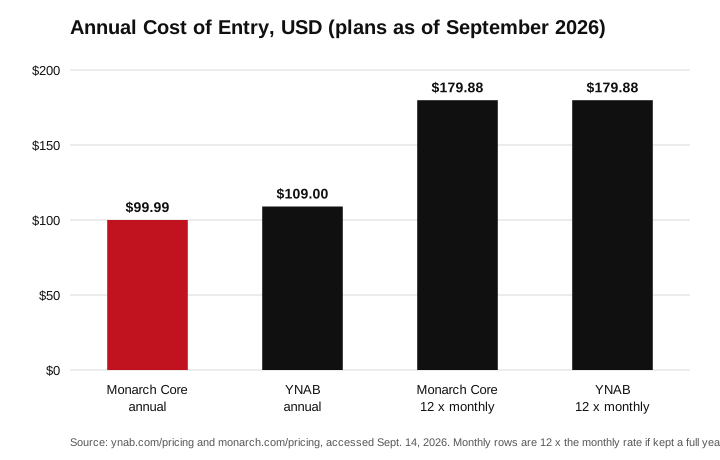
YNAB lists two prices: $14.99 a month or $109 paid annually ($9.08 a month), plus tax where applicable, per its pricing page; direct signups get a 34-day free trial without a credit card. Monarch's Core plan runs $99.99 a year ($8.33 a month on annual billing) or $14.99 month to month, with a 7-day trial — its FAQ calls it your first week on us — per its pricing page. Monarch's Plus tier runs $199.99 a year, billed annually. Twelve months of monthly billing costs $179.88 at either service; the annual plans undercut that by $70.88 at YNAB and $79.89 at Monarch. Our subscription cost calculator runs the same arithmetic for any mix of recurring apps.
| Category | YNAB | Monarch Money |
|---|---|---|
| Entry annual price | $109/yr ($9.08/mo equivalent) | $99.99/yr Core ($8.33/mo equivalent) |
| Monthly billing | $14.99/mo | $14.99/mo Core |
| Free trial | 34 days, no card for direct signups | 7 days |
| People per subscription | Up to 6 via YNAB Together | No stated member cap, one subscription |
| Availability | International, single-currency budgets | US and Canada; USD/CAD accounts only |
| Premium tier | None | Plus, $199.99/yr, annual billing only; forecasting, business tracking |
Allocation vs. Flex Number
The documented workflows diverge at the first step. YNAB has users assign existing money to jobs and move money between categories when life disagrees with the plan; its support documentation describes plan owners sharing edit access to every account and transaction in a shared plan. Monarch's Flex Budgeting, described in a company blog post, sorts spending into fixed, non-monthly and flexible buckets and reduces the month to one number: income minus fixed, non-monthly and goal allocations. Monarch also supports traditional category budgeting, and its documentation says users can switch between the two styles in settings.
The distinction matters for households. YNAB's model is granular and reactive — every overspend triggers a decision. Monarch's flex model is deliberately coarse: one weekly or monthly spending number per person, with color thresholds at 50 percent and 100 percent. Neither is objectively correct; they encode different tolerances for administrivia.
Household Access: What Is Actually Shared
This is where the marketing undersells the mechanics. YNAB Together groups one billing owner with up to five invitees, each with an individual login, per its support guide. Plan owners choose which plans to share; members' plans are automatically visible to the group manager, and invitees must be 13 or older in the US and 16 or older elsewhere, with invitations expiring after 14 days. Monarch, per its household documentation, puts every member under one subscription with roles of Admin, Member and optional Professional for advisors — but states plainly that members cannot hide connected accounts or transactions from each other, and that a person with an existing Monarch account cannot be invited and must use a different email.
That last constraint is a genuine boundary, not an interface filter. Monarch's all-or-nothing visibility suits couples with fully merged finances and households working with a financial professional; it is a poor fit for partners who keep some accounts private. YNAB's plan-level sharing offers more gradations — a member can hold an unshared plan — but the group manager always sees every plan in the group.
Who Should Skip Both
Skeptics should note what the documentation does not promise. Monarch is available only in the US and Canada and recommends USD or CAD accounts, which excludes multi-currency households, per its FAQ. YNAB has no free tier after its trial — its pricing page is explicit that the trial is the only free path, with a separate free-year program for verified college students. Plus, several Monarch Plus features were desktop-only at launch, per the Plus help page. Anyone who wants a free ongoing tool, UK banking, or cross-border budgeting should stop reading here.
Neither company publishes accuracy or reliability statistics for its bank connections; both route data through third-party aggregators. This desk compares documented capabilities only and has not independently tested either app — see how we test and source budgeting app coverage.
The Pick
Pick YNAB if you want enforced zero-based discipline, plan-level privacy controls inside a group, and the lowest cost per person — $109 split across six users is about $18 per seat per year, and each member still gets a private unshared plan. Pick Monarch Money if your household wants one merged dashboard, advisor access, and a budget that tolerates real life without a category-by-category tribunal. For the shared-household use case this assignment targets, Monarch's joint view and role structure make it the better fit at $99.99 a year; YNAB remains the stronger choice for individuals committed to its method. Full context in our Monarch Money review and the budgeting apps hub.
FAQ
Can my partner and I share one subscription on either app?
Yes, on both. YNAB Together covers up to six people on one subscription, with the billing owner as group manager. Monarch puts the whole household under a single Core subscription with no stated member cap, each with an individual login, per its household documentation.
Keep Reading
Rocket Money vs PocketGuard: Bills and Subscriptions
Rocket Money averages $7–14 per month for Premium; PocketGuard asks $74.99 a year — and only one of them will cancel subscriptions for you.
Quicken Simplifi Review: Cash-Flow Planning Explained
What Quicken's own documents say Simplifi's 12-month cash-flow forecast can and cannot do.
Rocket Money Review: Subscription Tools and Pricing
What Rocket Money's free tier covers, what Premium's $7–$14 sliding scale buys, and where the cancellation and negotiation fees hide.